
January 14, 2026
How Freeze-Thaw Cycles Wreck Paver Patios (and How to Prevent It)
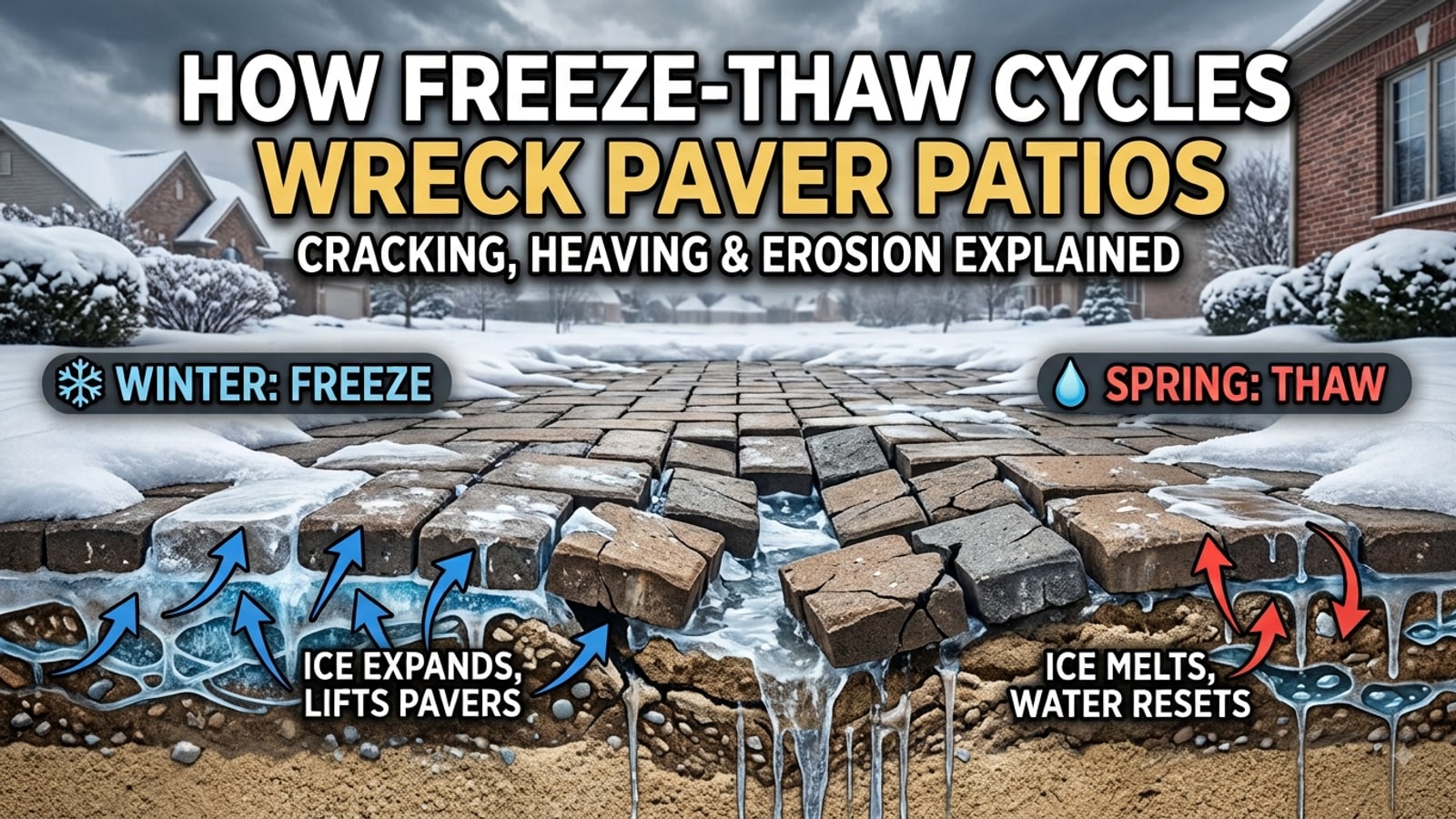
If you’ve lived in northern Michigan for more than a winter or two, you already know the drill: the ground freezes, it thaws, it freezes again, sometimes several times in a single week during a warm spell in March. Most people think of this as background weather. For a paver patio, it’s structural load — and it happens somewhere between 80 and 120 times a year here, depending on the winter.
What’s actually happening underground
Water in the soil beneath a patio expands roughly 9% in volume when it freezes. If that water is trapped in a poorly draining base, that expansion has to go somewhere — and “somewhere” is usually up, pushing pavers unevenly as the ice forms, then leaving voids when it melts. Do that a hundred times a winter for a few years and you get the classic symptoms: pavers that rock underfoot, a patio surface that’s developed a wave, or joints that have opened up and filled with weeds.
The soil type makes a real difference in how bad this gets. The sandy soil common closer to Lake Michigan drains fast and holds less water, so it’s more forgiving. The heavier clay pockets further inland — which we see a lot of around Charlevoix and the inland parts of Emmet County — hold water much longer, which means more time for that water to be sitting in the base when a freeze hits. We adjust our base depth and drainage detailing based on which soil we’re building on, not a one-size-fits-all spec.
The base is the whole ballgame
This is the part that’s invisible once the patio is finished, which is exactly why it’s the part that gets cut on cheap installs. A properly built base for our climate is 8 to 10 inches of compacted aggregate — not just dumped and leveled, but compacted in lifts (thin layers, each one run over with a plate compactor before the next goes down). Skipping the lift-by-lift compaction is one of the most common shortcuts we see when we’re called out to fix someone else’s failed patio; the base looks fine on day one because loose aggregate holds its shape until the first hard freeze finds the weak spots.
Underneath that base, we use woven geotextile fabric to separate it from the native soil. Without this layer, fine soil particles migrate up into the aggregate over a few seasons, clogging the pore spaces that are supposed to let water drain through and creating exactly the kind of trapped moisture that causes heaving.
Jointing sand matters more than people think
Standard sand in the joints between pavers washes out over time and lets water pool right at the surface, close to where freeze-thaw damage does the most visible harm. We use polymeric jointing sand, which hardens after activation with water and stays locked in place. It also resists the weed growth that plain sand practically invites — another reason patios with standard sand joints tend to look tired within a few years even if the base underneath is fine.
Grading away from the house
None of the base work matters if water has nowhere to go. Every patio we build grades a minimum of 1/4 inch per foot away from the house, so water isn’t sitting against the pavers — or worse, your foundation — waiting for the next freeze.
What to do if your patio is already showing signs
Minor unevenness in a joint or two can sometimes be corrected by lifting the affected pavers, adding base material, and resetting them. But if you’re seeing widespread heaving, multiple low spots holding water, or pavers that shift when you step on them, that’s usually a sign the base itself failed — and patching individual pavers won’t fix a base problem. At that point, a full rebuild with proper base depth and drainage is the only fix that actually lasts, which is unfortunately something we do more often than we’d like for patios that were built to a cheaper spec a few years back.
The good news: a patio built correctly for this climate the first time genuinely doesn’t need this conversation again for decades.
Interested in Paver Patios?
Custom-designed paver patios built on a compacted base engineered for northern Michigan's freeze-thaw cycles.
Learn more about Paver Patios →